An artist is judged on images, not on text. That is obvious, and it is exactly what makes an online portfolio technically hard: the visuals meant to impress are also what drives the visitor away before anything appears.
The contradiction is solvable, but it takes work most portfolios skip. The result is a beautiful site nobody waits to see load.
The conflict between image quality and speed.
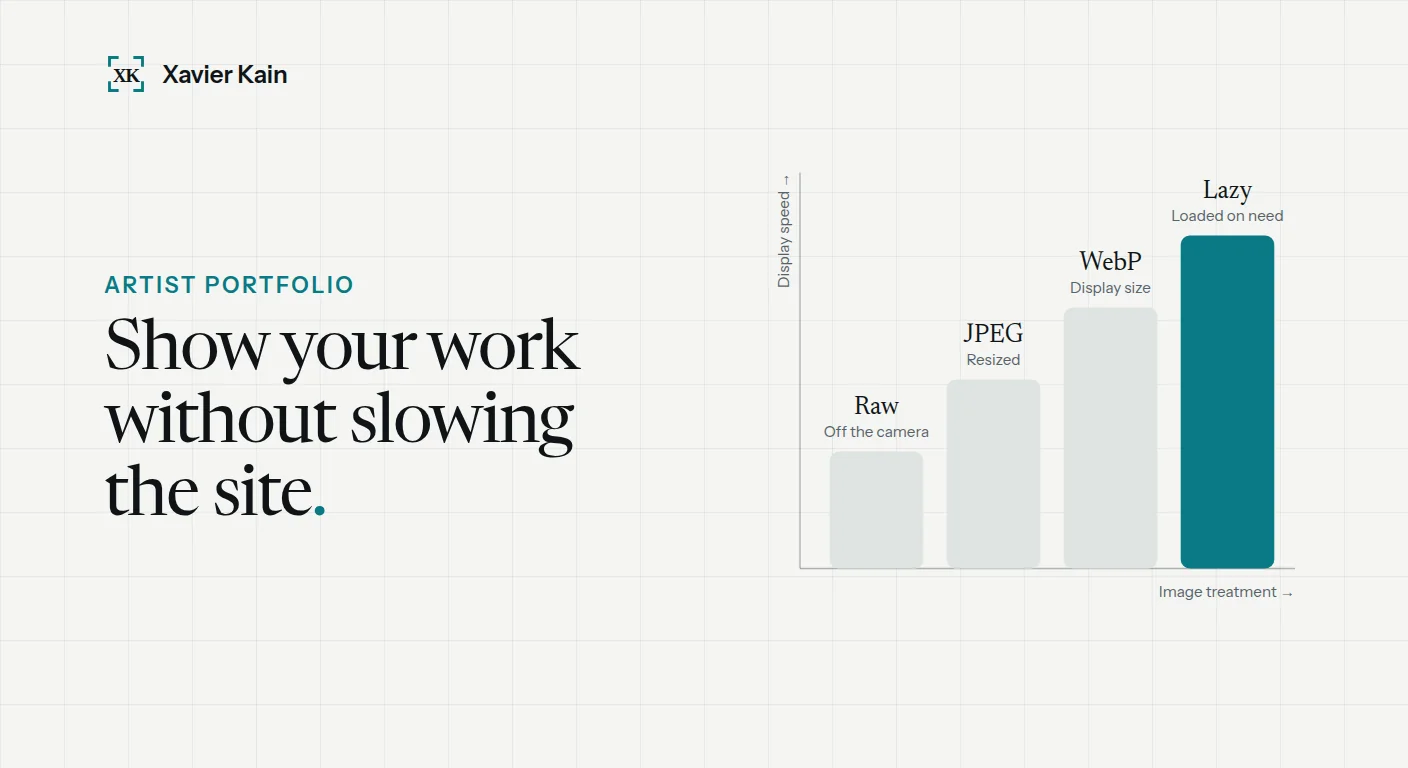
A full-resolution photograph of a work weighs several megabytes. A gallery of twenty unoptimised images easily passes twenty megabytes — tens of seconds on an average mobile connection.
The visitor does not see a beautiful image arriving slowly: they see a blank page, and they leave. The paradox is that an unoptimised portfolio works against the very work it exists to show.
| Treatment | Typical weight | Across 20 images |
|---|---|---|
| Straight off the camera | 4 to 8 MB | 80 to 160 MB — unusable |
| JPEG resized to 2000 px | 400 to 800 KB | 8 to 16 MB — still too heavy |
| WebP at display size | 80 to 200 KB | 1.6 to 4 MB — acceptable |
| WebP + lazy loading | same, but 4 loaded first | under 1 MB on first paint |
What to actually do.
Four steps are enough, and they can be automated once rather than repeated for every new work.
- Serve the right size: a thumbnail shown at 400 px does not need a 3000 px file.
- Use WebP with a JPEG fallback: 30 to 50 % lighter at the same visual quality.
- Defer everything below the fold: only the first images load immediately.
- Declare dimensions in the markup: without them the page jumps as images arrive.
The honest test
Open your portfolio on a phone using mobile data, not wifi, and time it. Past three seconds before the first image you lose half your visitors — and they are the ones who came to see the work.
How many works to show.
Twelve to twenty, selected. Beyond that the visitor stops looking and starts scrolling. A portfolio is curated as often as it is added to, and removing a piece is an artistic decision as much as an editorial one.
The selection should answer a precise question: who is this portfolio for? A gallery, a curator and a private buyer want different things and should not see the same selection first.
What is almost always missing
Context. An image with no title, year, medium or dimensions is unusable by a professional — and unindexable too. Those four pieces of information turn a gallery into a catalogue.
The artwork record, field by field.
Seven fields turn a gallery of images into a usable catalogue: title, year, medium, dimensions, availability, provenance, and either a price or a line inviting contact. None of them is decorative. Each answers a question a professional asks before writing to you, and a question Google asks before ranking you.
Dimensions belong in centimetres, height then width, depth for three-dimensional work. A gallery planning a hang thinks in linear metres of wall: without dimensions it cannot plan anything and moves on to the next artist. A collector, meanwhile, measures the wall before replying.
| Field | For the professional | For indexing |
|---|---|---|
| Title and year | Places the piece in a working period | Named queries: artist plus title |
| Medium and support | Drives conservation and insurance | Queries such as "oil on canvas", "glazed stoneware" |
| Dimensions | Hanging, shipping, crating cost | Size filters in Google Images |
| Availability | Prevents enquiries on sold pieces | The availability field in structured data |
| Provenance and shows | Gives a jury something to trust | Cites venues already indexed |
Availability is the most neglected field and the most profitable one. A sold work left unmarked generates enquiries you then decline one by one; a sold work marked as sold proves the work sells, which reads better than a catalogue that has been fully available for three years.
Then there is price. Showing it speeds up the decision below roughly £1,700 and filters out enquiries outside the budget. Above that, "price on request" is defensible: negotiation depends on context, on the buyer and on any gallery agreement. The real problem is not the choice, it is mixing both at random on the same page.
The artist statement: two versions, not one.
An artist statement becomes unreadable for three specific reasons: abstraction with no example, sentences over forty words, and catalogue vocabulary used by an artist writing about themselves in the third person. Readers usually give up at the second paragraph.
You need two versions, not one, because two different readings coexist. The short one, 100 to 150 words, sits on the home page and in metadata: it says what you make, with what, and what you are after. The long one, 400 to 700 words, lives on its own page and carries the application dossier.
Who actually reads it
- A residency or grant panel comparing eighty applications in a day, giving yours two minutes.
- A gallerist trying to work out whether your practice holds over three years or only over one series.
- An arts journalist who needs two quotable sentences that do not have to be rewritten.
- A buyer, who mostly wants to understand what is going on the wall and be able to explain it.
The short version has to survive cutting. If only the first sentence remains, it must still say something concrete: a material, a gesture, a subject. "An enquiry into the limits of representation" says nothing; "large oil paintings made from photographs of building sites" is remembered and searched for.
Write it out loud
Record yourself explaining your work to someone who knows nothing about it, then transcribe. The result is almost always clearer than what you would have typed, and all that is left is cutting the hesitations.
Exhibitions and the artist CV.
An artist CV is skimmed top to bottom, and nobody gets past the second year listed if nothing there registers. The expected structure is fixed: reverse chronological, solo shows first, group shows next, then residencies, awards, public collections and bibliography.
Every line follows the same format: year, exhibition title in italics, venue, city, country when it is abroad. A venue with no city cannot be verified, and a panel that cannot verify treats the line as if it were not there. That is blunt, but it is what happens.
What a gallery looks at in thirty seconds
- Consistency: three lines a year across five years weigh more than twelve lines in 2023 and nothing since.
- The solo to group ratio: a single solo show in ten years raises a question, however good the group shows are.
- Institutional venues, however modest: a municipal art centre counts for more than a café that hangs work.
- Unexplained gaps: two empty years get noticed, and a residency or production line is enough to fill them honestly.
A downloadable PDF dossier is still asked for, because a committee forwards it by email and prints it. Aim for 12 to 20 pages, under 8 MB so it clears mail filters, with an explicit file name such as firstname-surname-dossier-2026.pdf. A file called dossier_final_v3.pdf disappears inside a bulk download.
The PDF does not replace the page
A PDF indexes poorly compared with an HTML page, and it does not update. Publish the CV as text on the site and offer the PDF alongside: the first makes you findable, the second makes you forwardable.
Getting images found.
Google Images is a genuine discovery channel for an artist, often ahead of web search by volume. Four things determine what the engine understands from a photograph of a work: the file name, the alternative text, the visible caption, and the structured data.
| Element | Avoid | Write |
|---|---|---|
| File name | IMG_4472.jpg | camille-dubois-nuit-blanche-2025-oil.jpg |
| Alternative text | painting | Deep blue oil on canvas, 120 × 90 cm, Nuit blanche series |
| Visible caption | Untitled | Nuit blanche, 2025, oil on canvas, 120 × 90 cm |
| Structured data | none | VisualArtwork with artist, medium, dimensions |
Alternative text describes the work for someone who cannot see it: it is an accessibility requirement first and a search signal second. A useful length is around 80 to 125 characters. Stacking comma-separated keywords does the opposite of what is intended and makes the site unusable with a screen reader.
The schema.org VisualArtwork type takes the properties that matter: artform, artMedium, artworkSurface, width, height and dateCreated. No rich result is guaranteed in search pages; the point is to describe the work in vocabulary that search engines and language models read without ambiguity.
Budget one to two minutes per work to fill in those four levels properly. Across a fifty-piece catalogue that is half a day, once. It is also what most portfolios never do, which makes the gap easy to open.
An image never ranks on its own: it is judged along with the page around it. A single gallery of twenty visuals with thirty words of text gives the engine nothing to read. Past about thirty works, give each piece its own URL, with its record and its text; below that, a well-described series page is enough and costs less to maintain.
The newsletter as the strongest sales channel.
An Instagram post now reaches a fraction of your followers, and you choose neither which fraction nor when. An email reaches everyone, with open rates commonly between 30 and 45 % on a genuinely built list of art buyers. It is the only channel you actually own: the list follows you if the platform changes its rules or shuts down.
The useful size is lower than people assume. Three hundred to eight hundred qualified addresses, gathered at private views, at fairs and through the site, are enough to sell pieces in the £400 to £2,500 range regularly. A bought list of ten thousand addresses is worth nothing, and would expose you to a penalty on top.
A cadence you can hold
- Six to ten sends a year: each show, each new series, and a year-end round-up.
- A preview reserved for the list 48 hours before it opens publicly: that is what gets the next email opened.
- Three to five works per send, not fifteen: people choose better from a short set.
- No email beats a filler email: unsubscribes track content that was not worth sending.
On cost, the usual tools stay free up to roughly 500 or 1,000 contacts, then move to £15 to £35 a month. Wiring the sign-up form into an existing site is half a day to a day of work, a modest line inside the overall site budget.
The legal frame is easy to respect: explicit consent, no pre-ticked box, a visible sender identity and an unsubscribe link in every message. An address collected from a business card at a private view is not consent: offer the sign-up, do not assume it.
Selling online or prompting contact.
For prints, series or fixed-price pieces, direct sale works: the buyer decides alone and the act is simple. For unique pieces or commissions, the contact form converts better than a basket.
The reason is simple: above a certain amount, nobody buys a work without a conversation. Forcing a checkout where the buyer wants dialogue loses the sale.
Key points
- A slow portfolio works against the work it shows: WebP, right size, lazy loading.
- Twelve to twenty selected works beat an exhaustive gallery.
- Seven fields per work, availability included: without them the image is neither usable nor indexable.
- Two versions of the statement, a verifiable reverse-chronological CV and a PDF under 8 MB.
- File name, alt text, caption and VisualArtwork: two minutes per work, once.
- A basket suits prints, a form suits unique pieces, and the newsletter sells better than social media.
FAQ — Artist portfolios.
Do you need a site if you are already on Instagram?
Instagram shows recent work to people already following you. The site is consulted by galleries, curators and buyers before a decision — and it is still readable in five years, which a feed is not. They serve different moments.
How do you stop images being taken?
No technical protection defeats a screenshot. What works is serving images at display size rather than full resolution, and keeping originals offline. A watermark is an aesthetic choice before it is a protection.
What does a portfolio site cost?
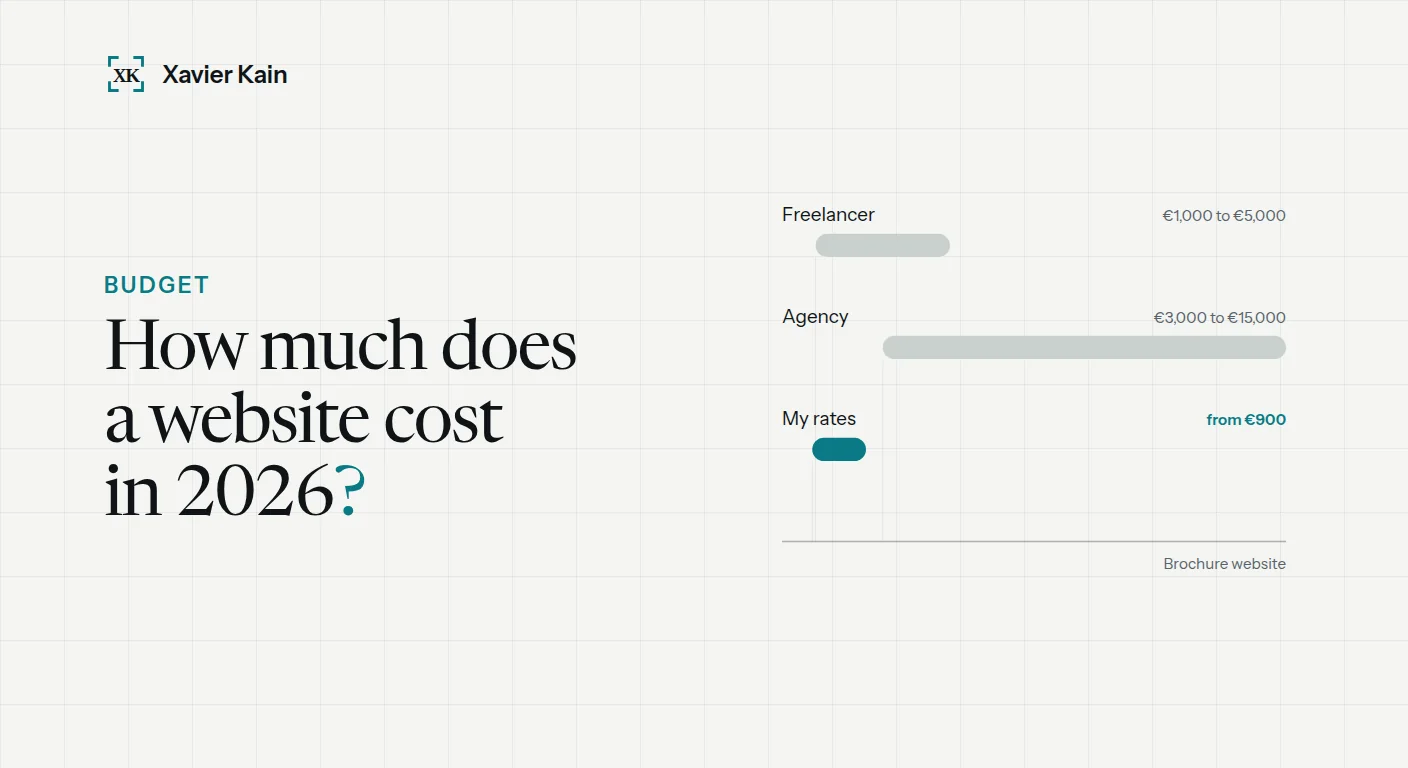
From €1,500 for custom WordPress website development, or from €3,500 with an online shop. The main variable is how many works need preparing and whether there is a shop. Preparing images often takes longer than building the site.
Do you need a multilingual site?
If you exhibit or sell abroad, yes — English at minimum. A real translation, not an automatic widget: titles and artist statements lose a great deal to machine translation.
Should prices be shown on a portfolio?
Yes below roughly £1,700: the price filters out enquiries outside the budget and speeds up the decision. Above that, "price on request" is defensible, provided it applies to a whole range rather than to random pieces. The worst case is a page where some works show a price and others do not, with no visible logic.
Who pays for shipping and insurance on a work sold online?
The buyer, usually, but the amount has to be stated before the order. A 120 × 90 cm canvas, crated and insured, often costs £130 to £350 to ship domestically. Announcing a flat rate per size band avoids cancellations at the payment step.
Sources.
- Google — SEO Starter Guide — structure and best practice
- web.dev — Learn Images — formats, sizing, loading
- schema.org — VisualArtwork — artwork properties
- Google — Image SEO best practices — Google Images, alt text
- CNIL — Email marketing rules — consent and unsubscribe