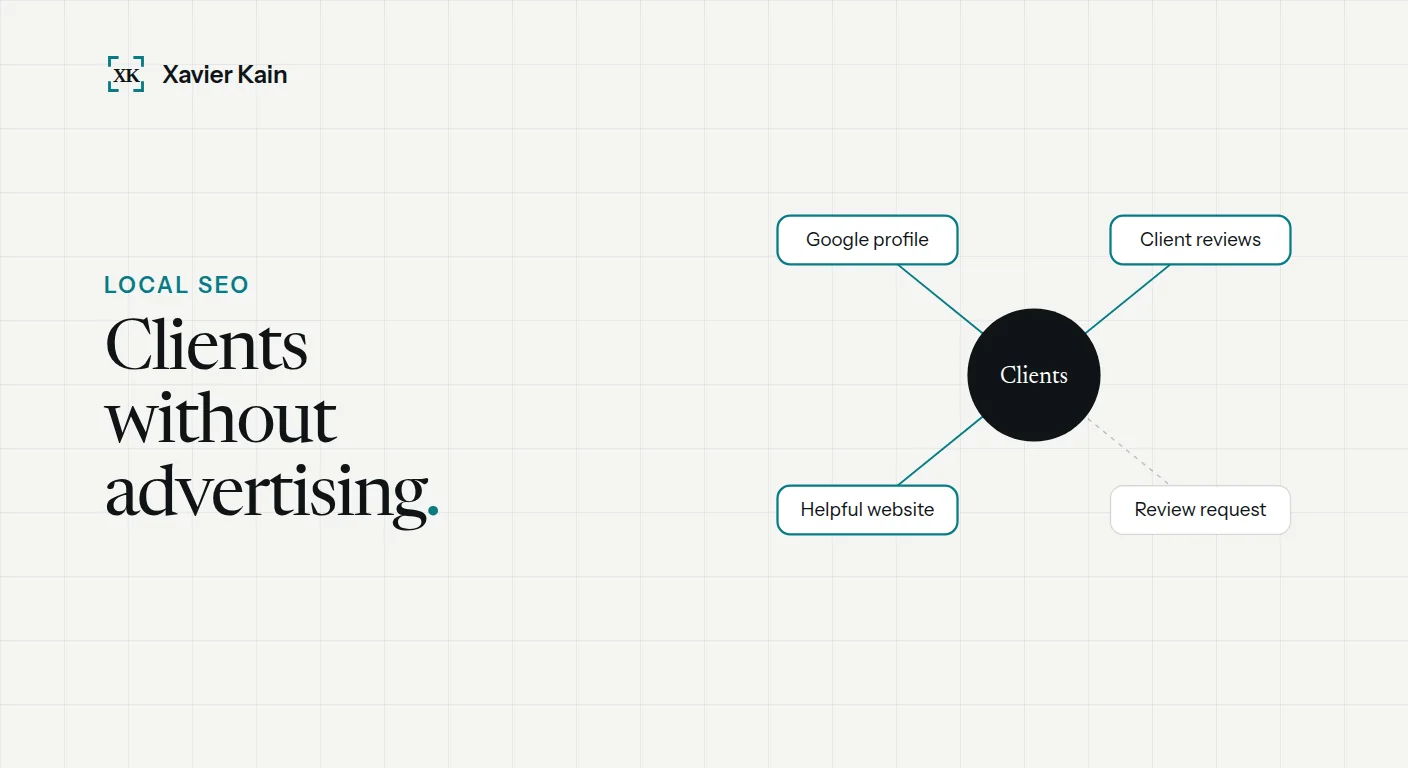
Without an advertising budget, a small business finds clients through three tools that reinforce each other: a complete Google Business Profile, which puts you on the map; a steady flow of genuine client reviews, which tips the choice between you and a competitor; and a website that answers the client's questions and turns a visit into an enquiry. None of them involves paying for clicks, all of them take consistency. It's slower than a campaign, but the results don't vanish the day you stop paying.
I've been a freelance web developer since 2017 and have delivered more than 200 projects, many of them for sole traders and small businesses that have never run an ad. Here's what works, with real examples.
Why these three tools rather than advertising?
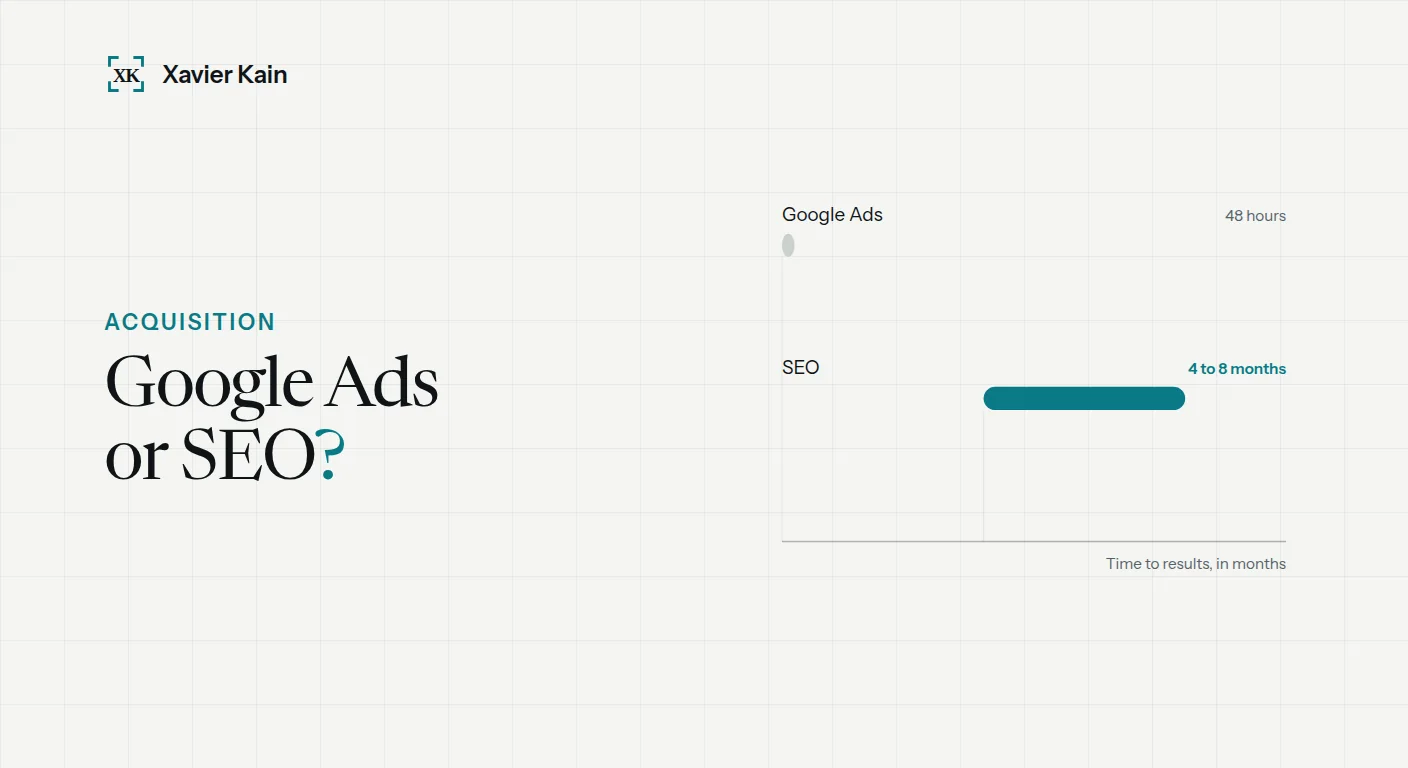
Advertising isn't a bad idea: it brings visits from the very next day. Its drawback is that it rents your visibility. The day the budget stops, you disappear from the results, and nothing you paid for stays. I compare the two approaches in detail in Google Ads or SEO: which should you choose.
Your Google profile, your reviews and your website, on the other hand, are assets. Every review received, every photo added, every page that answers a question well keeps working years later. For a business that doesn't want to depend on a monthly budget, that's where to start. Advertising can come later, to speed up what already works.
How does a client actually find you?
The path of a client who doesn't know you is nearly always the same:
- they type their need into Google ("plumber leak", "osteopath near me", "wedding caterer") or ask an AI assistant;
- they see a map with a handful of businesses, their stars and their number of reviews;
- they read a few reviews, especially the most recent and the worst;
- they click through to the website to check services, prices and past work;
- they call, book or send an enquiry, if it's easy.
You can lose them at every step. An incomplete profile and they don't see you. Few reviews, or none answered, and they pick the business next door. A slow, vague website with no visible contact and they go back. These three tools aren't three options: they're three steps of the same path.
What should go on your Google profile?
Google itself explains that local ranking rests on three criteria: relevance to the search, distance, and the prominence of the business, where the number of reviews and the ratings count (its advice is here). You can't control distance, but the rest is largely up to you:
- The right primary category, the one that describes your trade the way clients search for it, then precise secondary categories.
- Accurate area, opening hours and phone number, identical to those on your website.
- Your services, one by one, each with a short description.
- Real photos: your premises, your team, your work. No stock images.
- The link to your website, ideally to the most useful page rather than the home page.
Details matter. For La Peana, three houses to rent near Tarifa, I labelled the site's map "La Peana, El Cuarton" so travellers wouldn't confuse the property with a place with an almost identical name on Google Maps. For Bombora, a café restaurant in Lille, the "Visit us" block on the home page links straight to Google Maps. The profile and the website must tell the same story. To go further, read website or Google profile: do you need both?
How do you get reviews without buying them?
Most satisfied clients don't leave a review of their own accord. They simply don't think of it. The only lasting method is to ask every client, at the right moment:
- right after the job, while their satisfaction is fresh;
- with the direct link to your profile, which Google provides in your management dashboard, so the client has nothing to look for;
- through the channel they already use with you: text, email or message, in one sentence.
What not to do is just as clear. Google's rules forbid fake reviews and reviews obtained in exchange for something, and its guidelines for businesses also forbid asking only happy clients. In the UK and the EU, fake reviews are also banned by consumer law. The risk: reviews removed, or even a penalised profile.
Then reply to every review, positive and negative. Your reply to criticism is read by all your future clients: it should be calm, factual and offer a solution. I set out the method in managing your Google reviews.
Finally, put your reviews to work on your website. For Addict Kite School, a kitesurfing school in Tarifa, client reviews appear directly on the three-language site, next to the pre-booking form. Visitors don't have to go back to Google for reassurance. My own reviews are gathered on the client reviews page, for the same reason.
What should the website do that the profile can't?
Your Google profile gets you found. Your website gets you chosen. It answers the questions the profile can't handle:
- one page per service, with what's included, who it's for, and a price range or how the price is worked out;
- proof: past work, real cases, reviews;
- who you are, with a face and a name;
- an obvious next step: call, book, request a quote, in one tap on a phone;
- a fast site, because most of these searches happen on mobile.
On the sites I deliver, the main action is always visible. For Bombora, the brief was to make the "Commander" (order) button as visible as possible: it stays in the fixed menu. For Dr Dubès's practice, a dental surgeon in Nice, the appointment button leads to Doctolib and the contact page carries an access map. For 2A Recouvrement, I added online appointment booking and fixed the form's sender address so enquiries no longer landed in spam: a form whose messages get lost costs you clients without anyone noticing.
The number of pages depends on your clients' questions, not on your competitors' sites: how many pages a website needs gives the method.
How do you make the three work together?
Separately, these tools work so-so. Linked, they reinforce each other:
- The same details everywhere: name, address or area, phone number and hours identical on your profile, your website and directories.
- The profile links to the website, and the website back to the profile (link to your reviews, access map).
- Reviews appear on the website, where the visitor hesitates.
- The website describes the business to Google with LocalBusiness structured data: name, address, hours, area. It's also what AI assistants read.
- Every quote request leads to a review request once the job is done. The loop is closed.
How long before the first clients?
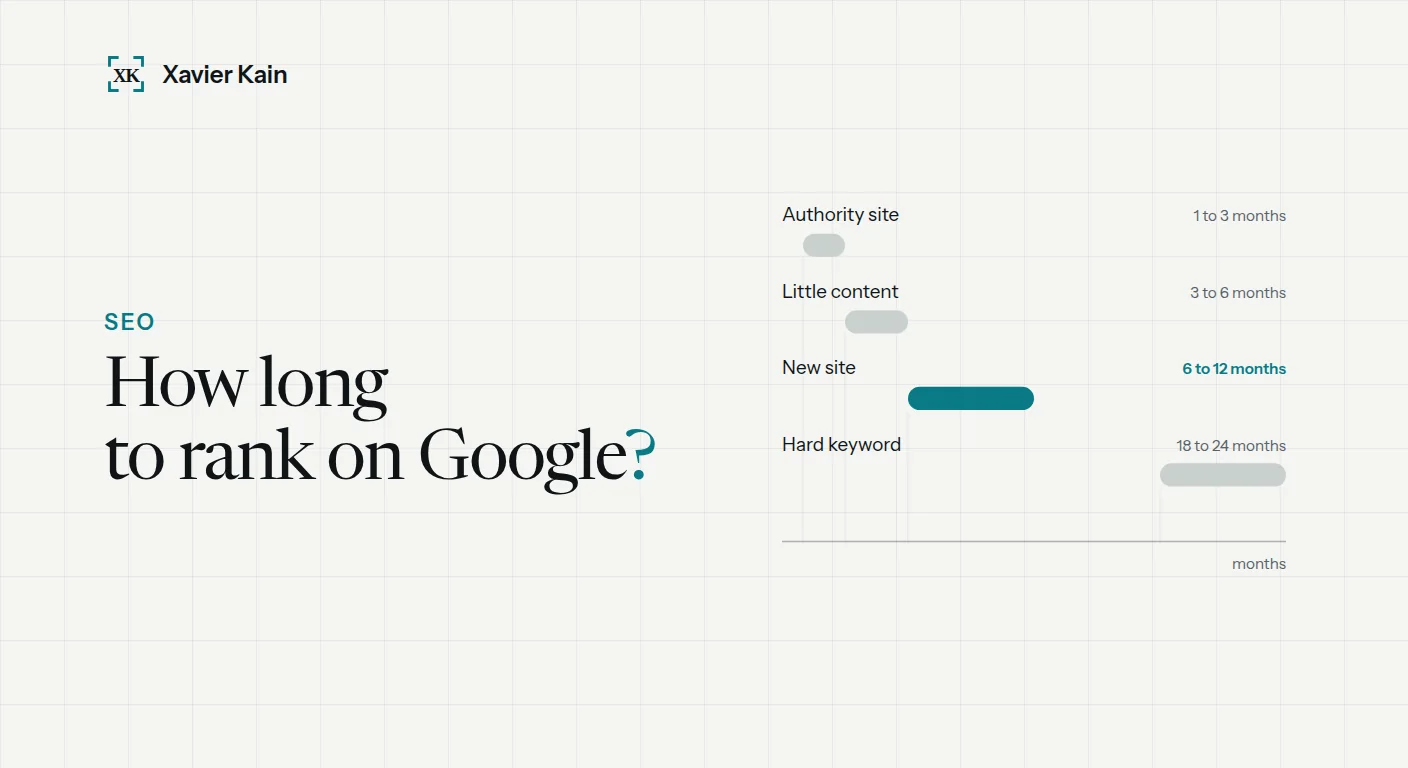
Let's be honest: it isn't instant. A well-filled profile and a few reviews can bring in calls fairly quickly, but Google promises no timeframe. For the website, the article how long it takes to rank on Google gives a benchmark: 6 to 12 months for a local commercial search.
That's the trade-off for not paying. Advertising buys time; these three tools take time, but what they build stays. If you need clients next month, a campaign can bridge the gap while the rest gets going.
Where to start this week?
- Check your Google profile: category, hours, phone number, services, real photos.
- Get the direct review link and send it to your latest clients, without filtering out the less happy ones.
- Reply to every unanswered review.
- Open your website on your phone: can you find in ten seconds what you do, who for, and how to reach you?
- If the answer is no, the website is what to fix first.
If your website isn't doing that job, I can rework it or build a new one. With me, a custom website starts at €900 excl. VAT and a simple WordPress website at €1,500 excl. VAT, delivered in about a week, with the basic SEO settings included (structure, speed, structured data); maintenance is available from €40 excl. VAT a month. See the WordPress website development page, describe your business, or book a 15-minute call.
FAQ: finding clients without advertising.
Can you really find clients without paying for advertising?
Yes, for most small local businesses and service providers. A complete Google Business Profile, a steady flow of reviews and a website that answers clients' questions are often enough. It's slower than a campaign, but the results don't stop when you stop paying.
Is a Google Business Profile enough without a website?
To be found on the map, it can be enough at first. To be chosen, rarely: the profile doesn't show your services in detail, your prices or your past work. The website answers the questions that decide the client, and the profile points to it.
How do you get Google reviews without buying them?
By asking every client, right after the job, with the direct link to your profile. Google forbids paid reviews, reviews in exchange for a discount and asking only happy clients. Then reply to every review, positive or negative.
How long does it take to get results?
Your profile and reviews can bring in calls fairly quickly, but Google gives no timeframe. For the website, expect 6 to 12 months for a local commercial search. The three tools reinforce each other: the more you look after them, the harder they work.
How much does a website for finding local clients cost?
With me, a custom website starts at €900 excl. VAT and a simple WordPress website at €1,500 excl. VAT, with the basic SEO settings included. Your Google profile and reviews are free; above all, they take consistency.
Sources.
- Google Business Profile Help: improve your local ranking, relevance, distance and prominence
- Google: prohibited and restricted content, the rules on fake reviews
- Google Search Central: LocalBusiness structured data, describing your business to Google