It is one of the first questions asked when quoting, and one of the worst framed. Page count is not a budget variable you pick: it is a consequence of how many questions your customers have before they contact you.
A tradesman doing one job in one area does not need twenty pages. A practice covering six areas across three cities cannot fit into five. The right method is to count the questions, not the pages.
The method: one page per decision-blocking question.
List the questions prospects actually ask — on the phone, in meetings, by email. Not the questions you wish they asked: the ones that recur and that, until answered, prevent a decision.
Any question that comes up more than three times a month deserves a page. Any question asked once a year belongs in the FAQ. It is the only criterion that produces a useful structure rather than a symmetrical one.
The ten-minute exercise
Open your inbox and reread the last twenty enquiries. Count how many open with the same question. That is your first page to write, and probably the most profitable on the site.
The irreducible core.
Whatever the trade, five pages are necessary. Below that, something is missing that the visitor will look for elsewhere.
| Page | What it settles | Common mistake |
|---|---|---|
| Home | Who you are, for whom, and what to do next | Describing the company instead of the customer's problem |
| Offer | What you actually do, and at what price | Staying vague "to keep options open" |
| Proof | Why believe you | A gallery with no captions or results |
| About | Who answers the phone | Three impersonal lines |
| Contact | How to reach you, and how fast | A form alone, with no phone or stated response time |
Legal notices and a privacy policy sit on top of that core. They do not convert; they are required — and their absence is a negative signal some visitors check explicitly.
When another page is justified.
Three situations, and only three, justify multiplying pages. Outside them, an extra page dilutes more than it adds.
- Two audiences looking for different things. A decorator working for homeowners and for managing agents has two offers, two vocabularies, two decision cycles. One page each.
- A service with its own search demand. If people type "exterior rendering" and not just "decorator", that service deserves a page.
- A recurring objection that needs room. Price, lead time, guarantee: when the answer fits a paragraph, it is an FAQ. When it needs a table and three examples, it is a page.
The town-page trap
Creating ten identical town pages with only the name changed does not produce ten rankings: Google indexes one and ignores the rest. A town page only has value if it says something true and specific about that town — real response time, districts covered, jobs completed there.
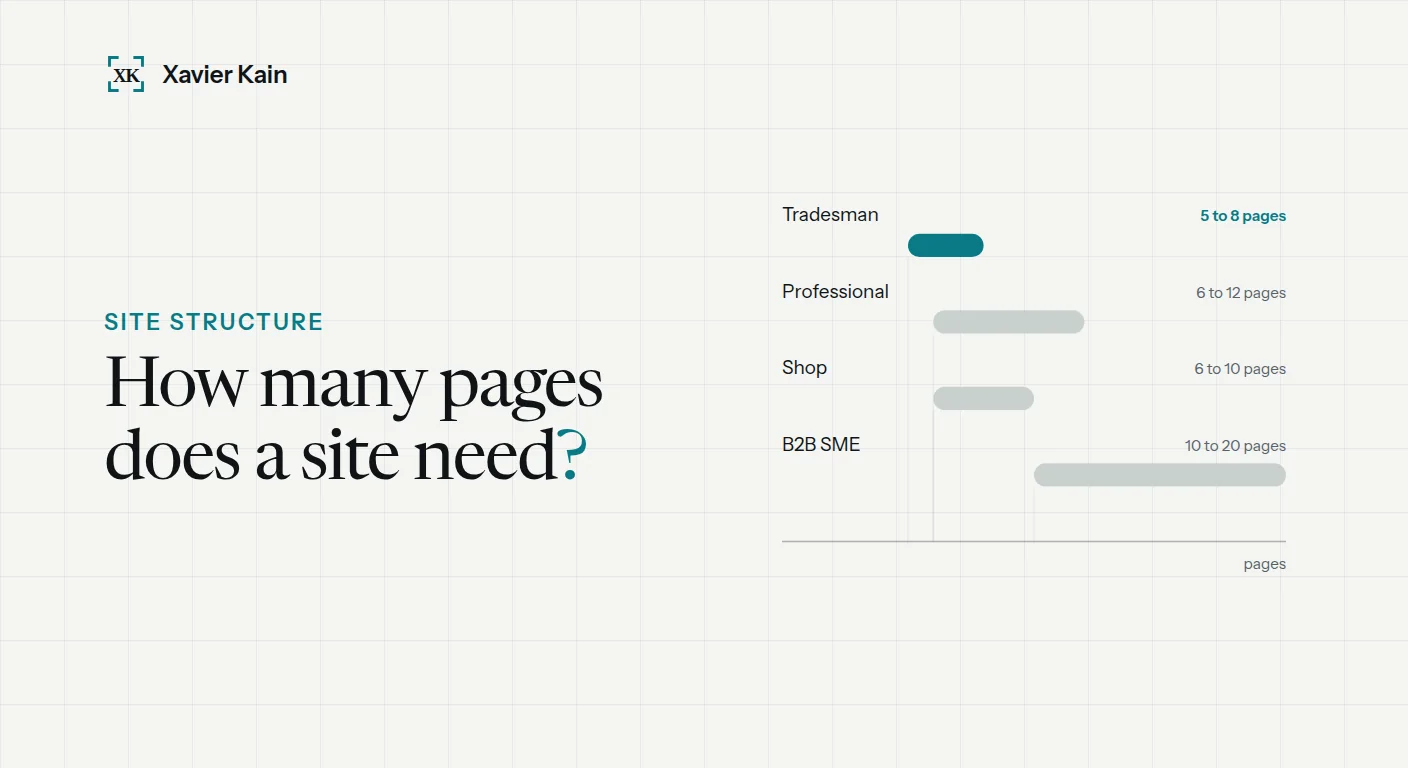
Orders of magnitude by situation.
These figures are reference points rather than rules, drawn from what works for comparable activities.
| Situation | Pages | What makes it vary |
|---|---|---|
| Tradesman, one trade, one area | 5 to 8 | Number of distinct services |
| Professional practice | 6 to 12 | Number of specialisms |
| Shop with a physical presence | 6 to 10 | The menu or catalogue |
| B2B SME | 10 to 20 | Number of markets addressed |
| E-commerce | catalogue + 8 | Product families |
| Industrial with catalogue | 50 to several thousand | One page per part or family |
Beyond twenty pages outside the catalogue, the question stops being count and becomes structure: which page is the pillar, which are satellites, and how a visitor moves between them without going back to the menu.
Four structures, four trades.
Orders of magnitude do not tell you which pages to build. Here are four structures stripped back to what genuinely earns its place, drawn from common activities.
Building trade, one area, three services
- Seven pages: home, three services, projects, about, contact
- The projects page carries dated jobs with duration, the constraint encountered and a price range — without those three, it is a gallery
- No town pages while a single area is covered: the Google Business Profile does that job better than a page can
Professional practice, six areas
- One page per area only if each has its own search demand; otherwise two pages grouping the adjacent ones
- A fees page, even without amounts: how you bill, what is included, one worked example
- A "what happens at a first appointment" page, almost always the most-read page before someone gets in touch
E-commerce
- The catalogue does not count in the editorial structure: it is generated from the products
- Eight non-catalogue pages suffice: delivery, returns, payment, buying guide, about, contact, terms, privacy
- Delivery and returns are the two most-read non-product pages before a first purchase; treating them as legal boilerplate is a conversion mistake
Industrial SME
- One page per market addressed rather than per product: the buyer searches for their application before searching for a part
- A capabilities page and a certifications page, both separate from the about page
- The technical catalogue lives apart, with its own filter logic and its own update rhythm
The marginal cost of a page.
On an existing site, adding a page costs almost nothing to build. The real cost is the substance: the information, the figures and the examples only you hold.
| Type of page | Writing time | Indicative cost |
|---|---|---|
| Standard service page | 3 to 5 h | time spent |
| Page with a price table or comparison | 5 to 8 h | time spent |
| Case study with client figures | 6 to 10 h | time spent |
| Town page with real local content | 4 to 6 h | time spent |
| Page needing a new template | Template and writing | time spent |
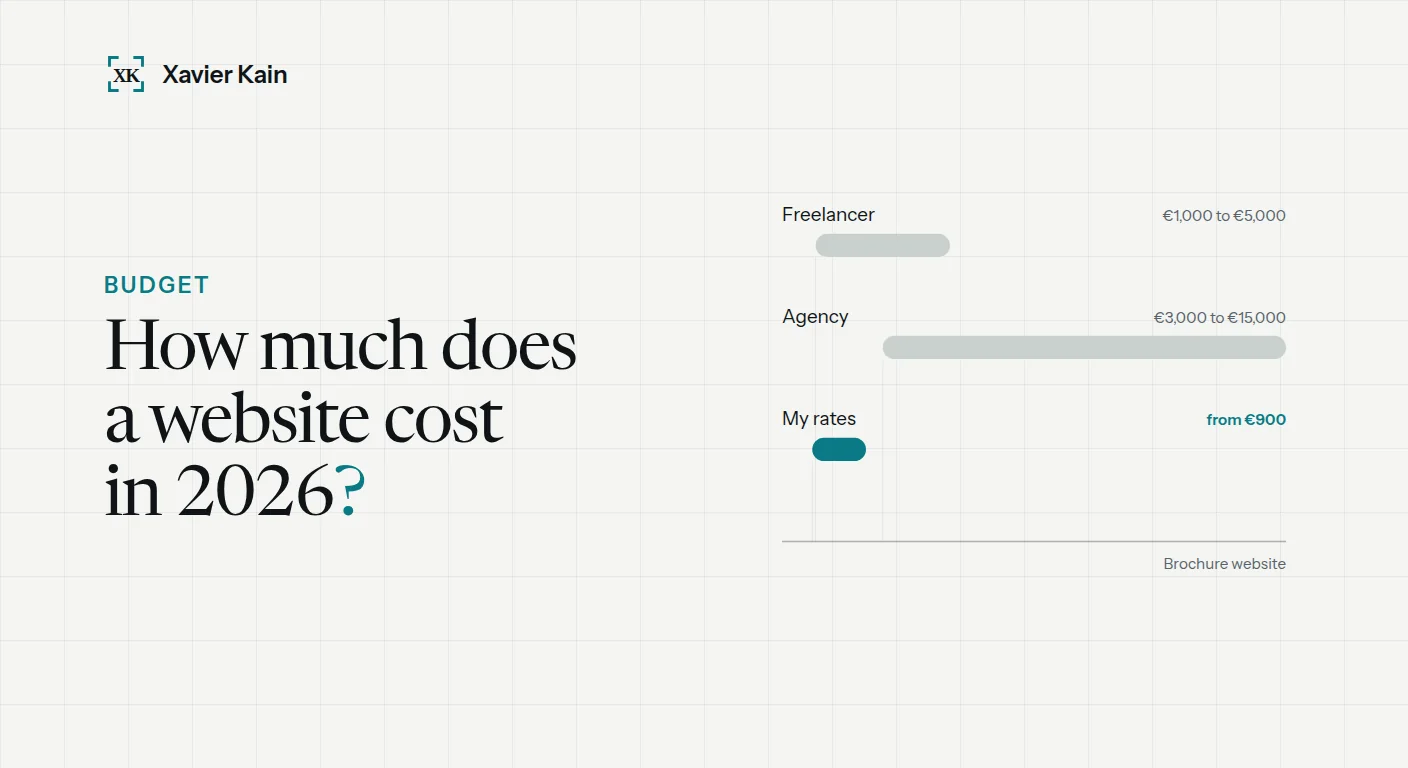
Those times assume an existing template. On a brochure site billed from €1,500, ten well-written extra pages often cost more than the site itself. That is logical: the site is a container, the pages are the content, and content does not get reused from one client to the next.
So the trade-off is rarely about money; it is about hours on your side. A case study takes two hours of your time to gather the figures and clear them with the client named in it. That availability, not the budget, is what limits how many pages a site can genuinely carry.
When a page hurts your search visibility.
Adding a page is not neutral. Two pages covering the same subject compete with each other: Google picks one, often the weaker, and the pair loses positions a single page would have held.
- Two pages on the same intent — "emergency plumber" and "plumbing callout" describe one demand: merge and redirect
- A page under 200 words with no data of its own — nothing to index, and internal authority spreads thinner
- A page no internal link points to — you are signalling yourself that it does not matter
- A page whose text exists elsewhere — copied supplier descriptions, trade-body boilerplate
The fix is almost always a merge rather than a deletion: combine the two weak pages into one complete page, 301-redirect the old URL, and update the internal links that pointed at it. The gain is usually measurable after six to ten weeks.
To spot candidates, one reliable signal in Search Console: a page picking up impressions on queries already covered by another page of the site, without ever getting past position twenty, is almost always a page to merge.
Town pages: the only version that works.
This is the most common request and the most badly executed. The starting intent is sound — a Leeds trade wants to appear in Bradford and Wakefield — but the usual execution, duplicating a page and swapping the town name, produces the opposite effect.
Those pages are treated as near-duplicates: one gets indexed, the rest are ignored, and the whole site looks less carefully made. Ten identical town pages are not worth ten rankings; they are worth one ranking and a degraded quality signal across the rest of the site.
- Jobs genuinely completed in that town, dated and photographed
- A response time specific to that area, different from the neighbouring one
- A real local constraint: dominant building stock, conservation area, specific planning rules
- A contact, branch or depot physically present there
The test fits in one sentence: if you can swap the town name for another without the page becoming untrue, the page does not deserve to exist. Three substantial town pages beat twenty hollow ones. For the remaining towns, a single "areas covered" page listing the districts and their response times is more than enough.
Growing a site without rebuilding it.
The most expensive reflex is rebuilding a site because it is five pages short. A full rebuild costs roughly 100 % of the original budget and resets the age your URLs have accumulated; adding pages costs a few hundred pounds and keeps what you already have.
A rebuild is decided on technical grounds, not editorial ones: a platform no longer receiving security fixes, a site that is not responsive, a load time optimisation can no longer rescue, or a structural inability to add a content type. Outside those four cases, you grow the site.
- Publish in batches of three to five pages, two or three times a year, rather than one annual push of twenty
- With each batch, reread and correct two older pages: that is what stops the site ageing unnoticed
- Check internal links after every addition: a page nothing points to serves nobody
- Do not change an existing URL without reason; if you must, redirect with a 301 and check indexing the following month
Ten pages a year sustained for three years gives you a thirty-page site where everything has been reread recently. The same volume delivered in one go gives you a thirty-page site where half will be out of date before it has been read once.
The hidden cost of a page.
A page does not only cost to create. It costs to maintain: it ages, its information goes stale, and a wrong page does more damage than a missing one.
That is the most common reason thirty-page sites become liabilities: half has not been reread in three years, the prices shown are no longer right, and the services described are no longer offered.
Key points
- Count your customers' questions, not your competitors' pages.
- Five pages form the core; beyond that, each page must settle a recurring question.
- A page costs substance, not build time: writing time (€490 per day), depending on what it has to prove.
- Two pages on the same intent damage each other: merge and redirect rather than add.
- A town page with no real local content adds nothing and may harm.
- Rebuild for technical reasons; for everything else, publish in batches of three to five pages.
- A page you will never reread is a page not to create.
FAQ — Number of pages on a site.
Can a one-page site be enough?
To validate an offer or sell a single service, yes. The limit shows quickly: a single page can only rank for one subject, and you cannot answer different questions without extending the scroll indefinitely.
Are more pages better for SEO?
No. What counts is the number of pages that answer a real search intent. Twenty pages that resemble each other are worth less than five distinct ones, and can weaken the whole site if Google judges them redundant.
Do you need a blog on top of the pages?
A blog helps when your customers have questions before they are ready to buy. If your work is emergency-driven, it adds almost nothing. If the decision cycle runs for weeks, it becomes the main acquisition channel.
What does an extra page cost?
It is billed on time spent, at €490 per day, depending on the writing involved, on an existing site. The dominant cost is never the build but the writing: a good page needs information only the client holds.
Should you delete pages that get no visits?
Not automatically. A page with no search traffic can still do conversion work: the pricing page is often reached by a click from elsewhere on the site, never from Google. Look at internal page views before deciding. Delete what is neither found nor read, merge what duplicates something else, and keep what answers an objection even at ten visits a month.
How many pages to start with on a tight budget?
Five careful pages, which means a simple WordPress brochure site from €1,500. Five pages that genuinely answer something beat twelve written in a hurry: weak pages are noticeable, and they will have to be rewritten. Then plan two or three extra pages each year, billed on time spent at €490 per day, at the pace of the questions that actually recur.
Sources.
- Google — SEO Starter Guide — page structure and hierarchy
- Google — Consolidate duplicate URLs — near-identical pages and canonicalisation
- Google — Creating helpful, reliable content — what makes a page worth having