A sports club is not looking for traffic, it is looking for members who stay. That distinction changes the whole design: what matters is not the home page but the path from "I'm curious" to "I'm signed up and I keep coming back".
Most club websites stop at the first third of that path. They describe the activity, publish a timetable as a PDF dated last season, and point to a contact form. All the administration stays manual.
The real journey of a future member.
Nobody joins a club without answering four questions in order: does this match my level, do the times work for me, what does it cost for a year, and can I try first.
| Stage | What the visitor wants | What makes them leave |
|---|---|---|
| Level | Is this for me? | A description that never states the level required |
| Times | Does it fit? | A PDF timetable, or one from last season |
| Price | What per year? | No price, or one buried in club rules |
| Trial | Can I test it? | No trial session, or one you cannot book |
The bookable trial session
It is the single feature that most changes a club site's conversion, and the rarest. A hesitant visitor does not have to phone, turn up, or commit: they book a slot and come.
The timetable, central piece and weak point.
The timetable is the most visited page on a club site, far ahead of the home page. It is also the one most often out of date, because it is published as an image or PDF and has to be remade at every change.
An HTML timetable updates in two minutes, reads on mobile, and becomes indexable: someone searching "yoga Tuesday evening" plus their town can land straight on it. A PDF never will.
- Filterable by discipline, level and day
- Readable on mobile without zooming — that is where most views happen
- Editable by a volunteer or coach, with no supplier involved
- With the coach's name: people often join for a person
Sign-up and renewal, where the time is won.
Paper sign-up costs a mid-sized club several hours of processing per season: data entry, chasing medical certificates, staged payments, certificates issued.
An online form connected to payment settles most of it. It issues the confirmation, stores the documents, and enables automatic renewal reminders — the moment a club loses most members through simple forgetfulness.
Under-18s, handled from the start
Parental consent and image rights must be collected separately from membership, recorded, and revocable. That means being able to remove a photo quickly — a constraint you design in at the start, not after a request.
One page per discipline, or a single activities page?
A multi-activity club always hesitates between an "Our activities" page listing everything and one page per discipline. The second option wins nearly every time, for a mechanical reason: nobody searches for "multi-sport club", they search for "judo" followed by their town. A dedicated page can carry that discipline + town pair in its title, its h1 and its address. A catch-all page carries none of them, or one at best.
It has a cost, and the cost is not in the development: it is in the content. Each page needs its own information — levels, times, coach, price, kit required. A club with eight sections that publishes eight near-identical 120-word pages ends up with eight weak pages instead of one decent one. The working rule: one page per discipline only if you have 300 specific words to write and someone willing to keep them current.
What a useful discipline page contains
- The times with the exact venue: many clubs are spread over two or three sports halls, and the visitor cannot guess it
- The minimum age and the level expected, including when the answer is "none"
- The coach's name and qualification
- The annual price, stating whether the governing body licence is included
- What to bring to the first session
The counter-example is real: a section with six members and no dedicated coach does not deserve its own page, a paragraph on the general page is enough. And every discipline page should link to the timetable already filtered on that activity, not to the full timetable. It is a URL detail of the "?discipline=judo" kind, but it saves the visitor from hunting for their slot in a forty-row grid.
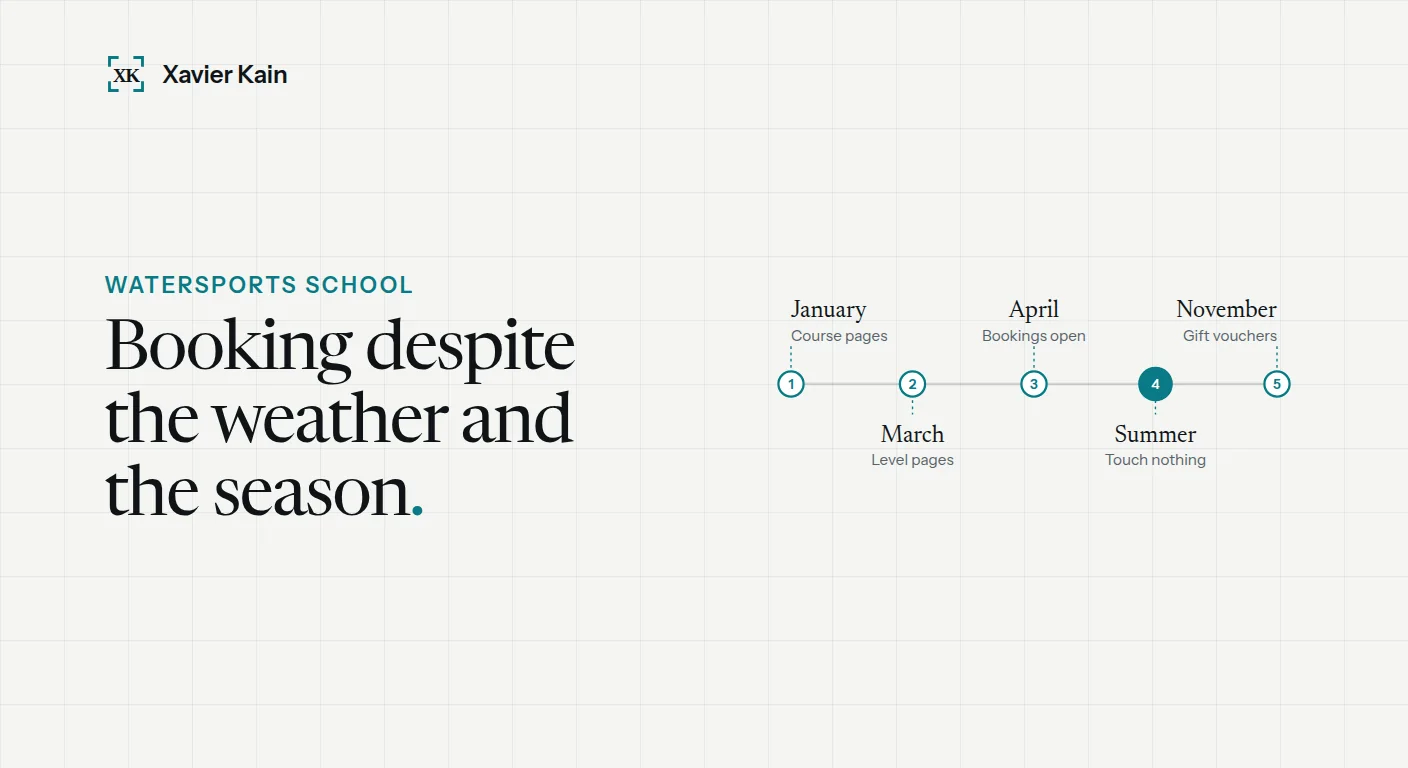
A club site ships in June, not in September.
Club sign-ups concentrate into roughly six weeks, from late August to mid-October, peaking around the local clubs fair in early September. It is common for 70 to 80% of a season's memberships to be signed inside that window. For the rest of the year the form runs almost empty.
The consequence is blunt: a site delivered in October has missed an entire season and pushes its return twelve months out. The realistic target is a site working by late June. Not because people join in June, but because the club needs two months to test the form with real parents, correct the prices, and print the web address and a QR code on the material handed out at the fair.
| Period | What happens | Why then |
|---|---|---|
| February to April | Scoping, feature trade-offs, prices for the coming season | Prices are voted at the annual general meeting, usually in spring |
| May to June | Development, and content written by the club | Volunteers are still available, which stops being true in July |
| Late June | Launch and testing in real conditions | Two months of slack remain before the first wave of sign-ups |
| August | Changes frozen, only the timetable keeps being updated | You do not edit a payment form the week of the clubs fair |
The common mistake is trying to ship everything at once for September. Splitting into two waves costs far less stress: timetable, prices and pre-registration for the new season, then online payment and automated renewal over the winter, when nobody is under pressure. The second peak, renewal in May and June, is usually forgotten — yet that is where a club keeps or loses a third of its numbers.
Medical certificates, health questionnaires and consent.
In France, since 2021, an under-18 no longer has to produce a medical certificate to obtain or renew a licence: a statement confirming the health questionnaire has been completed is enough. For adults the requirement depends on the governing body, on the discipline, and on whether the practice is competitive. The sign-up form therefore has to handle at least two cases, not one.
The technical point that matters: the club has no business knowing the answers to the questionnaire. It collects a statement, a box ticked under the member's or the parent's own responsibility. A home-made form asking "have you ever felt faint during exercise?" drags the club into processing health data, with everything that follows. It is a classic trap of forms improvised in a free survey tool.
What is collected separately
- The health questionnaire statement, or the medical certificate where it is still required
- Parental consent, separate from the membership form
- Image rights consent, separate from the above and revocable on its own
- The emergency contact, visible to coaches and to nobody else
Retention is decided before development, not after. A member's contact details are kept for the duration of membership, then moved to a separate base for outreach, the usual benchmark being three years after the last contact. Medical documents have no reason to outlive the season. A club that piles up ten years of certificates in a shared folder accumulates risk with no use for it. Scheduling their deletion at the end of the season is half a day of development and removes a decision that would otherwise come back every year.
Instalments, subsidies and pricing grids.
A club membership usually falls between £90 and £250 a year, with or without the governing body licence depending on the discipline. At that level the obstacle is not the amount: it is paying it in one go in late September, in the middle of back-to-school spending. Paying in three instalments removes a real objection, not a theoretical one.
Two implementations coexist. Staged direct debit through a payment provider is set up once and runs on its own, with fees around 1.5 to 2% per transaction. Deferred cheque banking costs nothing in commission but eats half a day of a treasurer's time per hundred members, every quarter. Automated instalments bring a second benefit that is rarely anticipated: you know immediately who failed on the second payment, without opening a folder.
The cases that complicate the grid
- A reduced rate from the second member of the same household
- Subsidies deducted at sign-up: France's Pass'Sport (€50), sport vouchers, employer schemes
- The member who joins in January and pays pro rata
- Dual membership, when someone practises two disciplines at the same club
Each of these adds a rule, and rules combine badly. A club with six rates and four stackable reductions ends up with a form where the final amount is never the one displayed. The trade-off states itself: either you simplify the grid before building, or you pay for every exception to be coded, billed on time spent, at €490 per day. Simplifying is free. And some subsidies still arrive on paper: plan a "finish this at the club" route rather than an unhandled case that strands the member at the last step.
Two audiences: current members and people looking for a club.
A club site serves two populations with almost nothing in common. Current members come for a changed time slot, a result, a call-up, a training camp date. Future members come for a price, a level, a trial session. Mixing them produces a home page covered in match reports, shown to somebody who only wanted to know whether the club takes beginners.
The split that works fits in one line. Public: home page, discipline pages, timetable, prices, sign-up, all written for someone who does not know the club and does not know your internal vocabulary. In a separate section: results, call-ups, AGM minutes, member directory. That second block does not need to be indexed, and is usually better off not being.
Does that justify a members' area? It moves the project up to a fuller brochure site with features (usually €2,000 to €2,500) and assumes somebody handles forgotten passwords every week of September. For many clubs it does not pay for itself: a monthly newsletter and a messaging group cover most internal communication without a line of code. A members' area starts to earn its place once there are documents that cannot be public, typically a directory with contact details or individual call-ups.
What must never sit in the open
Member lists with phone numbers, named result tables involving under-18s, and internal minutes. They regularly turn up in search results because they were dropped as PDFs into a public folder with no link to them. No link does not mean not indexed.
What it involves.
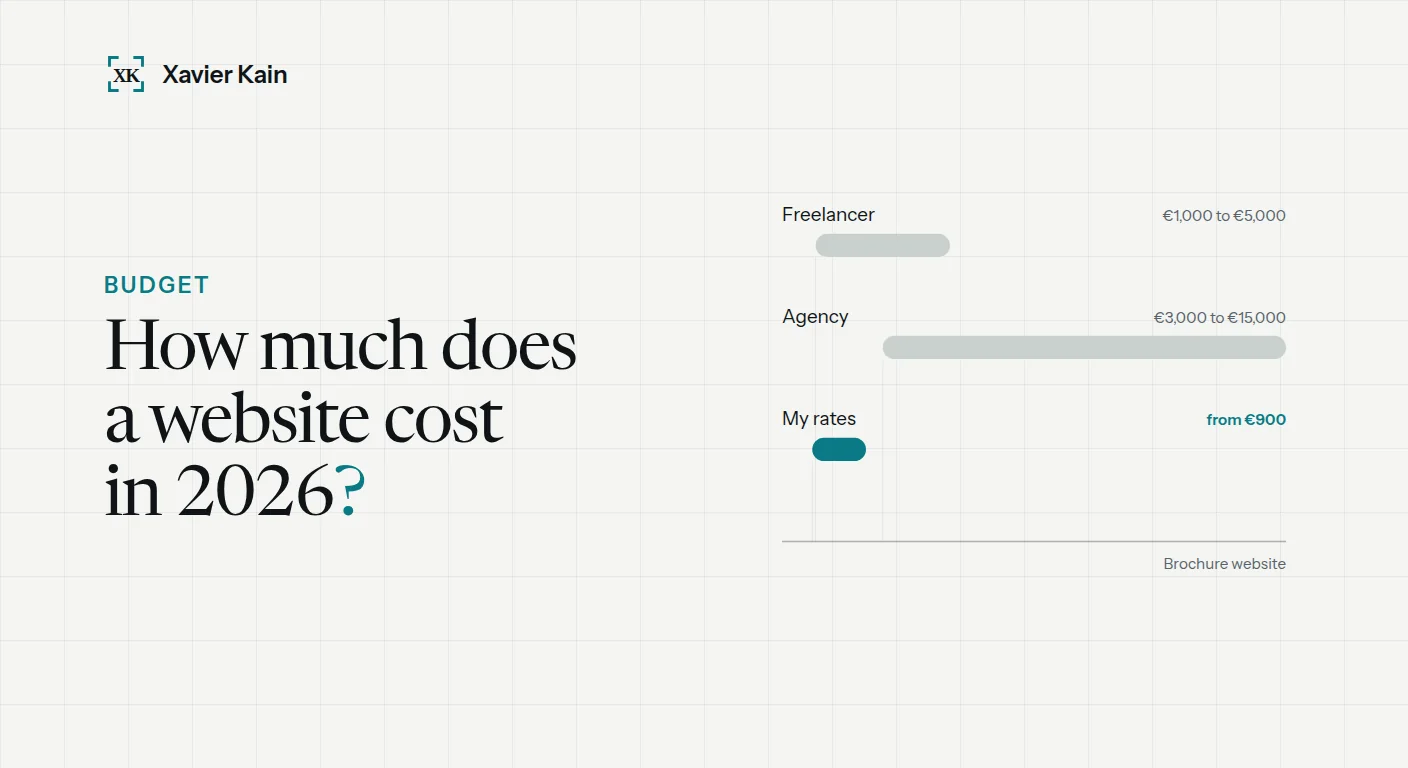
A club does not have a private gym's budget, and does not need one. The following ranges reflect common practice. The details of my custom WordPress website development offer are on its own page.
| Need | Budget | What it settles |
|---|---|---|
| Brochure site + HTML timetable | From €1,500 | Being consulted, being credible |
| + bookable trial session | Usually €2,000 to €2,500 | Converting the hesitant |
| + online membership and payment | From €3,500 | Administrative time |
Key points
- The timetable is the most visited page: in HTML, never PDF.
- A bookable trial session is the most effective conversion lever.
- One page per discipline only if you have 300 specific words to write and maintain.
- The site has to be working by late June, not September.
- Medical documents do not outlive the season: schedule their deletion.
- Simplifying the pricing grid costs less than coding every exception.
FAQ — Club and gym websites.
Does a club need a website alongside social media?
Social media serves the community that already knows you. The website captures those looking for a club without knowing any — and they want times, level and price before walking in. The two are complementary, not competing.
Can you publish photos of under-18 members?
Only with written consent from those with parental responsibility, separate from the membership form and revocable at any time. In practice that means recording who consented to what, and being able to remove a photo without delay.
Management software or a website?
Software handles the inside; the website captures the outside. Many clubs pay for software whose public page is useless for search. What works is an indexable site connected to the software for sign-up.
How long does updating a timetable take?
Two minutes if it is HTML and editable from an interface. Thirty if an image or PDF has to be remade — which explains why so many published timetables are out of date.
Does a club need a mobile app?
In almost every case, no. An app starts from €2,000 and has to be re-maintained at every iOS and Android release, for a use that mostly amounts to checking a timetable. A site that reads well on mobile does the same job, updates without store approval, and does not ask a still-hesitant visitor to download anything before walking in.
When should the project start to be ready for the new season?
February or March, for a late-June launch. Development takes one to two weeks, but most of the delay comes from the club itself: getting prices approved at the AGM, gathering the text for each section, finding usable photos. That is the work that slips, never the code.
Sources.
- Google — SEO Starter Guide — structure and best practice
- Google — How local results are ranked — relevance, distance, prominence
- Service-public — Medical certificate for sport — licence, under-18s, health questionnaire
- CNIL — Data retention periods — active base, archiving, deletion