To compare three website quotes, don't compare the totals. Copy all three into the same ten-line grid (scope, design, features, content, SEO, hosting and licences, maintenance, timeline, ownership, payment terms), mark what each one leaves out, ask each provider to price the gaps, then work out the cost over three years. The cheapest quote is often the one that says the least. The right one is the quote where every line is written down in black and white.
I have been a freelance web developer since 2017 and have delivered more than 200 projects. I have written a lot of quotes, and read just as many for clients torn between several offers. This is the method I give them, including when it doesn't work in my favour.
Why do three quotes for the same website never match?
Because they almost never describe the same website. One provider prices five pages on an adapted theme, another a design created from scratch with a blog, a third adds copywriting. All three are answering "a brochure website", but they are not selling the same work.
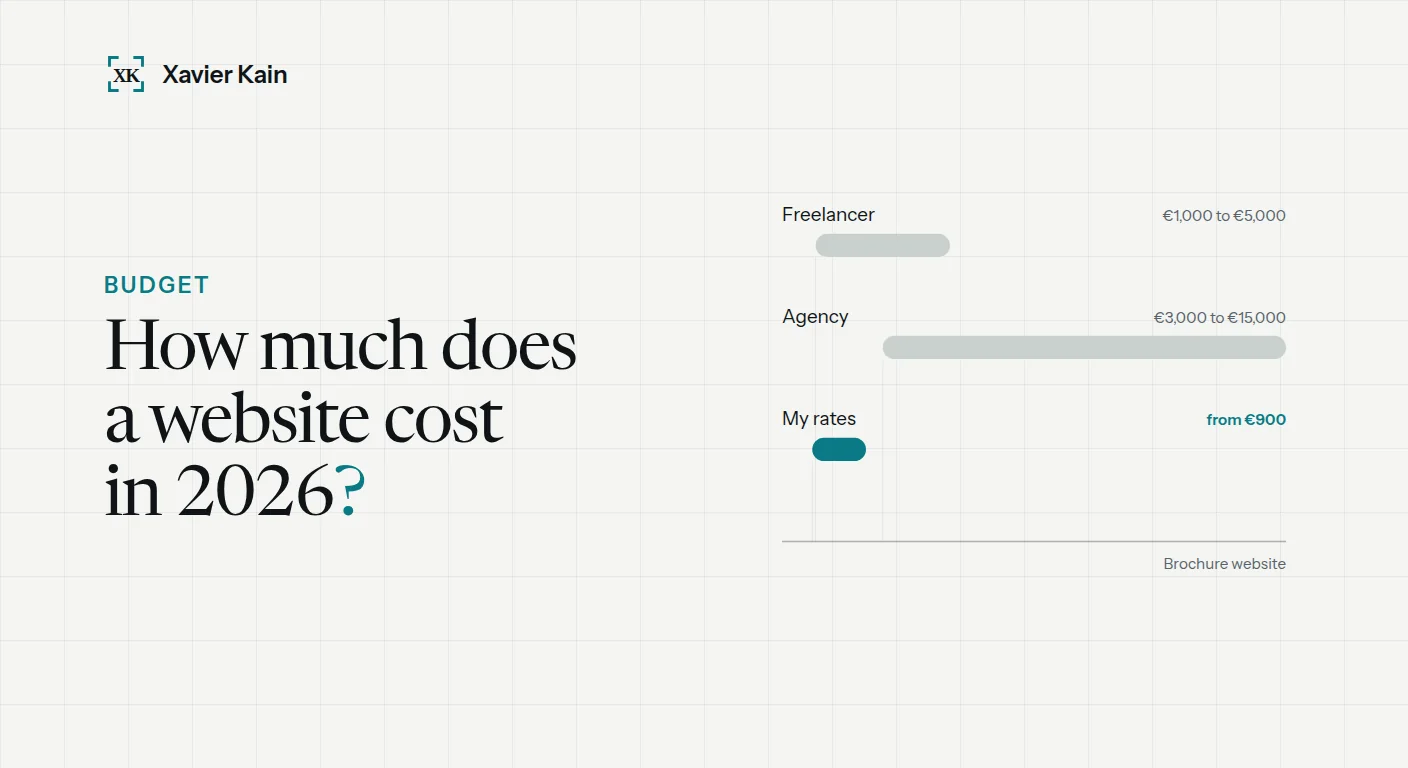
The type of provider matters too. On the French market, a brochure website most often costs €1,000 to €5,000 with a freelancer and €3,000 to €15,000 with an agency, and a freelancer's day rate is usually between €300 and €700 (these ranges are set out in the website pricing guide). A gap of one to three between two quotes is therefore nothing unusual. What matters is knowing what each one contains.
Hence the rule: you don't compare prices, you compare lists. The price comes last.
Which grid should you use to put quotes side by side?
Take a spreadsheet or a sheet of paper, one column per quote, and one row for each of the ten items below. Each cell gets one of three answers: "included and described", "mentioned without detail", "missing". The empty cells are the ones that will cost you later.
| Line | What to look for | Question to ask |
|---|---|---|
| 1. Scope | The list of pages and page templates | How many pages, which ones, and what does one more page cost? |
| 2. Design | Adapted theme or bespoke design, number of revision rounds | How many rounds of changes are planned? |
| 3. Features | Form, booking, payments, multilingual, client area | Is each feature named and tested? |
| 4. Content | Copy, photos, translations, uploading | Who writes, who supplies the images, who puts them online? |
| 5. SEO | Technical SEO, tags, speed, structured data | What is actually done, page by page? |
| 6. Hosting and licences | Domain, hosting, paid theme and plugins | Who pays what each year, and in whose name? |
| 7. Maintenance | Updates, backups, fixes | Is it included, optional or compulsory? |
| 8. Timeline | Delivery date and milestones | What happens if the content arrives late? |
| 9. Ownership | Code, admin access, domain name | Can I leave with my website without asking anyone? |
| 10. Payment | Deposit, instalments, terms | At which stages do you pay, and for what? |
Once the grid is filled in, send each provider the list of their "missing" cells and ask them to price them. You then have three comparable prices, which you did not have at the start.
Is the scope really the same in all three quotes?
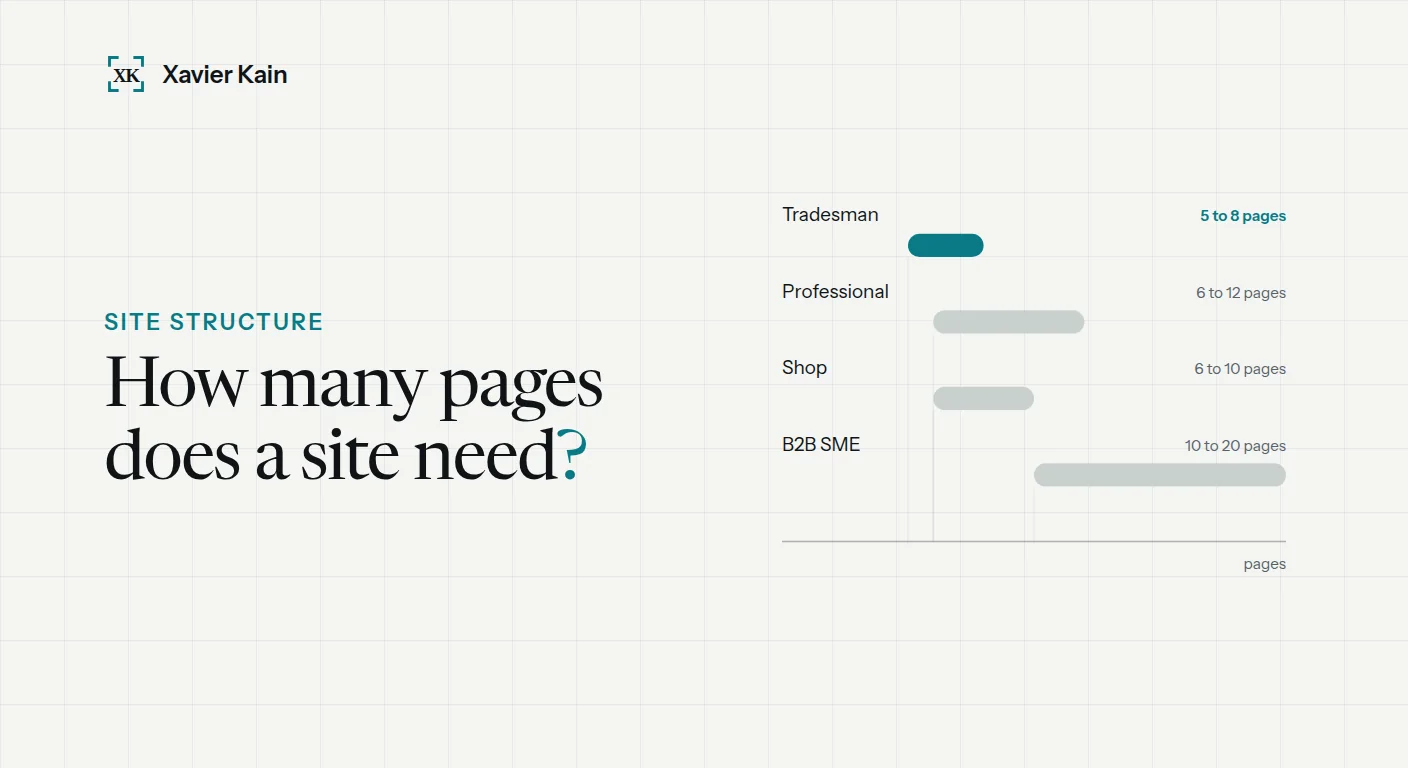
This is the first line to check, and the one most often left vague. "Five-page brochure site" does not say which five. A precise quote lists the pages (home, services, about, work, contact, legal notice) and says whether a "service" page is a single page or a template repeated for each of your services. To get your bearings, see how many pages a website needs.
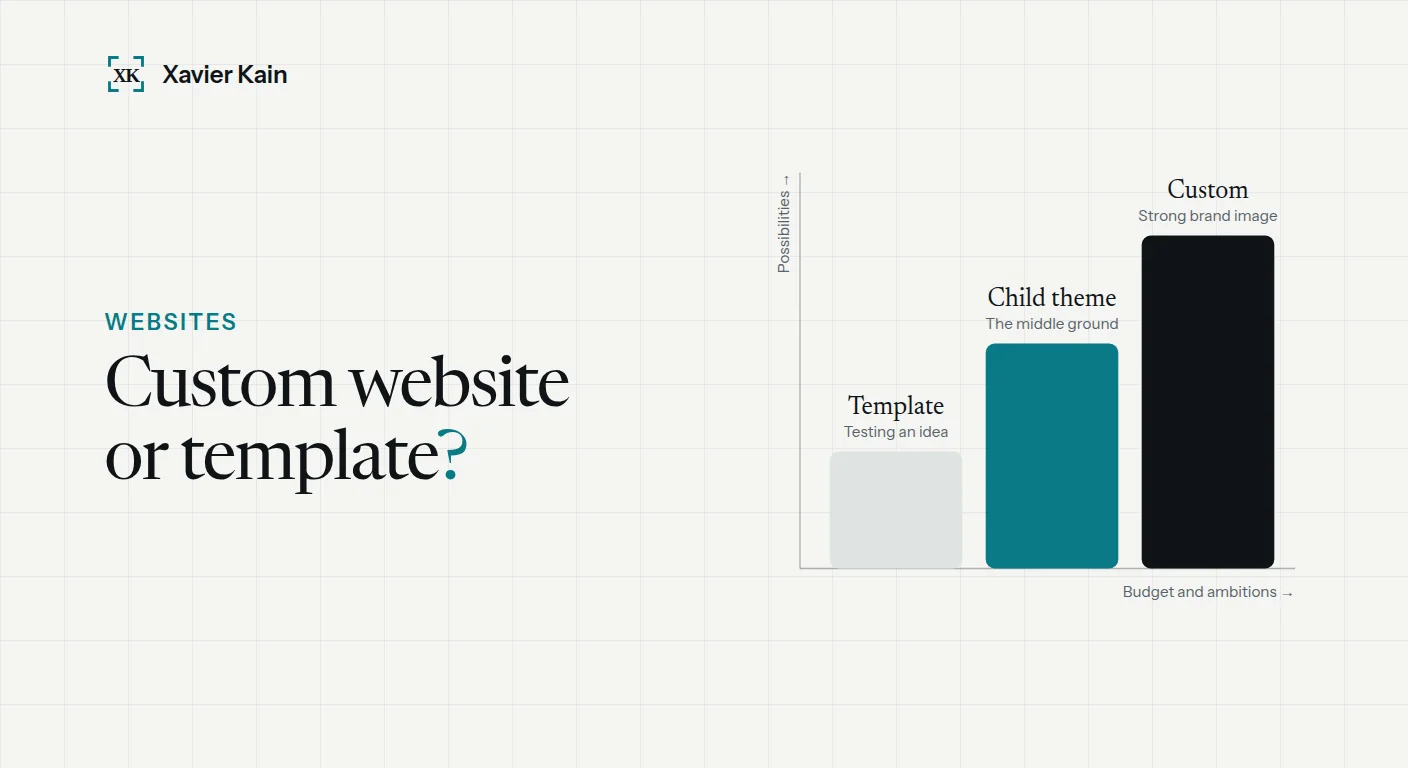
Then check the design. A theme adapted to your brand costs less than a design created from scratch, and both are legitimate choices (the custom website vs template comparison covers both). What is not legitimate is not knowing which one you are buying. Look at the number of revision rounds too: with no written limit, every round of feedback turns into a negotiation.
Finally, list the features by name. "Contact form" and "online appointment booking" take neither the same development time nor the same testing. If a quote simply says "bespoke features", ask for the list.
Who provides the copy, the photos and the translations?
This is the line cheap quotes most readily forget. A website cannot go live without content, and producing it is often underestimated: copywriting, professional photos, videos, translations for a multilingual site.
There are three cases. You supply everything and the provider puts it in. The provider reworks your existing copy. Or the provider writes it. Each has a different cost, and a quote that says nothing on the subject usually assumes the first. Check who uploads the content as well: putting thirty product pages or twenty blog posts online takes time, and that time has to appear somewhere.
Is SEO included, and which kind?
"SEO included" can mean anything. Two things need separating. The technical groundwork is part of any well-built website: heading structure, tags, page addresses, internal linking, structured data, loading speed (Google explains the basics). An ongoing content strategy, with regular articles and link building, is a separate service, invoiced separately.
A serious quote says what will be done on your site, not just that "SEO is optimised". If it is a redesign, add a question: will the old page addresses be redirected to the new ones? Without that, a site can lose years of Google rankings.
Which costs come back every year?
The build price is only part of the budget. Every website has annual costs, whoever builds it: the domain name (usually somewhere between ten and twenty euros a year), hosting, any theme or plugin licences, often renewed yearly, and maintenance.
Two quotes can show the same build price and very different annual costs, for example if one relies on several paid plugins and the other does not. Ask for the list of licences at quote stage, then add up build and running costs over at least three years. That total is what you should compare. For orders of magnitude, see the web hosting comparison and the website maintenance guide.
On maintenance, look at its form as well: included, optional or compulsory. Optional maintenance you can cancel is a good sign. Compulsory maintenance without which you cannot access your own site is a bad one.
Who will own the website, the domain and the logins?
This is the line that costs the most when it is badly written. Check three things:
- The domain name is registered in your name, not the provider's.
- You receive every login: site admin, hosting, domain.
- The code belongs to you and can be taken over by another professional if needed.
If a quote ties you to hosting you cannot leave, or to a site built on the provider's own proprietary tool, you are not just paying for a service: you depend on them for every change. That is not necessarily a deal-breaker, but you need to know before you sign.
Which red flags should you look for in a quote?
- A single-line package, with no list of pages or features.
- "Premium plugins included" without saying which ones, or who pays to renew them.
- No written timeline, or a timeline with no milestones.
- Nothing about content, as if the copy would write itself.
- A price far below the other two, with no explanation of what was left out.
- The domain or the logins kept by the provider.
- No comparable work to show, and no reviews you can check.
None of these flags rules out a quote on its own. They tell you which questions to ask before signing.
Which questions should you ask before signing?
- What does an extra page or feature cost once the contract is signed?
- How many rounds of design changes are included?
- Which paid licences does the site use, and what do they cost each year?
- Who will be my contact during the project, and afterwards?
- What happens if I want to change provider in two years' time?
- Can I see a comparable site you have delivered, and talk to that client?
The answers matter as much as the price. A provider who answers these six questions quickly and precisely gives you a fair preview of what the project will be like.
The most effective approach is still to start from a written brief: if all three providers receive the same document, their quotes will be far easier to compare. The website requirements generator produces one in a few questions, ready to send to several providers.
What does one of my quotes look like?
Since this article teaches you to judge a quote, I may as well explain how mine are put together. They are fixed-price and broken down by stage: you know what is delivered, when, and which options remain open. Technical and on-page SEO is included. The source code and every login belong to you. Maintenance is optional, from €40 excl. VAT a month.
Prices follow a public rate card, excluding VAT: custom HTML/CSS website from €900, simple WordPress website from €1,500, fuller showcase website usually €2,000 to €2,500, WooCommerce store from €3,500, web platform or web application from €5,000. As a rule, allow a week for a simple WordPress site, two weeks for a fuller site and three weeks for a store. The full list is on the services page.
Several of my clients have been with me for years, Med'Com since 2021 and Ksapa since 2019. If you already have two quotes in hand, send me your brief: mine will be itemised line by line, so you can drop it straight into the same grid. You can request a quote for a WordPress website or book a 15-minute call to talk it through.
FAQ: comparing website quotes.
Should you always get three quotes for a website?
It isn't compulsory, but two or three quotes give you a useful point of comparison. Beyond that, comparing becomes hard and the time spent often outweighs the benefit. What matters most is sending the same written brief to each provider.
Is the cheapest quote always the worst?
No. A low price can come from a smaller scope, an adapted theme rather than a bespoke design, or lower overheads. You need to check, line by line, what has been left out compared with the other quotes.
How do you compare an agency quote with a freelancer's?
With the same grid. An agency involves several people and charges for project management; a freelancer is your single point of contact. Compare scope, content, SEO, annual costs and ownership of the site, then the total price over three years.
What if a quote gives almost no detail?
Ask for the list of pages, features, licences and the timeline. A serious provider will supply it without fuss. If they refuse, that tells you something in itself.
Should a website quote include maintenance?
It should at least say whether maintenance is included, optional or compulsory, and at what price. With me it is optional and starts at €40 excl. VAT a month for a WordPress site.
Sources.
- Google Search Central: SEO starter guide, the basics of search engine optimisation