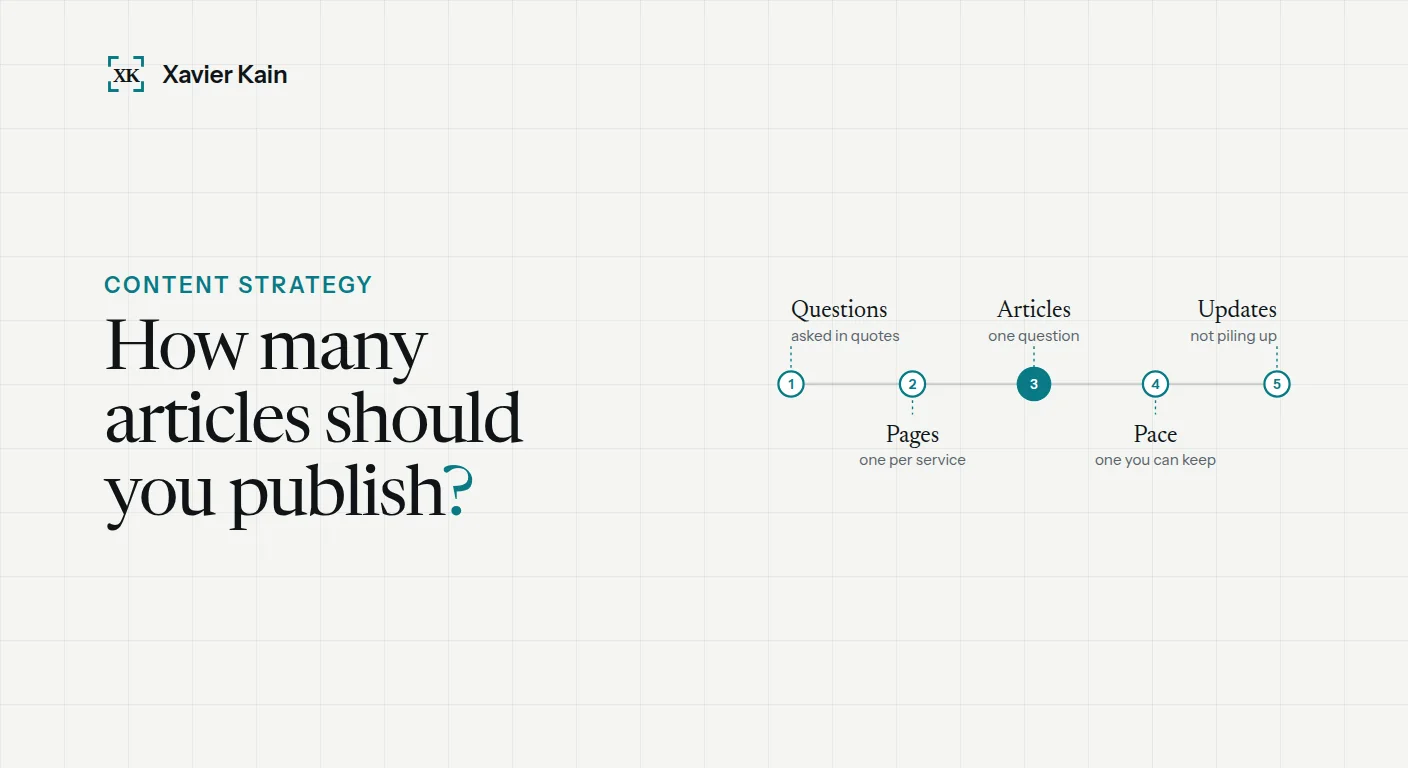
For a small business, a content strategy that works doesn't start from a calendar but from the questions your clients ask before they buy. First, one solid page per service; then articles that each answer a single real question (price, choice, process, objection), published at a pace you can keep up for at least a year. The right number of articles isn't an industry figure: it's the number of questions that keep coming up in your quote requests. One solid article a month for two years beats twenty articles in one month followed by nothing.
I've been a freelance web developer since 2017 and have delivered more than 200 projects, including several company blogs. This site follows the method described here: every article answers a question a client has asked me, and several are now cited by ChatGPT on budgets, choosing a provider and website strategy.
Does a small business really need a blog?
Not always. If most of your clients come through referrals, if they already know your name when they search, and if your service pages answer what they want to know, a blog isn't the priority. Improving the pages you already have will pay off sooner.
A blog earns its place in one specific situation: when your future clients look for answers before they know who to contact. "How much does… cost", "what's the difference between…", "how does… work": these searches don't include your name. Whoever answers them best becomes the first business the prospect thinks of. It's also what AI assistants read when someone asks them the same question.
Where to start: pages or articles?
With pages. An article attracts a reader who is researching; the service page is what turns them into an enquiry. If the reader clicks through to a vague services page, the article has done its work for nothing.
Before writing your first article, check you have the foundations: one page per service saying what you do, for whom, at what price or on what pricing logic, with proof and an easy way to reach you. The number of pages follows from the number of questions your clients ask, as I explain in how many pages a website needs.
Which topics should you choose?
Open your inbox and reread your latest quote requests, your call notes and the questions raised in meetings. Every question that recurs is an article topic. The most frequent ones go first, because they match searches that other people run without ever emailing you.
These questions almost always fall into five families:
| Family | Example title | What it does |
|---|---|---|
| Price and budget | How much does [your service] cost? | The reader is already comparing |
| Choice and comparison | [Option A] or [option B]: which should you choose? | You help them decide, so you become the reference |
| Process | How [your service] works, step by step | You remove the fear of the unknown |
| Problem or objection | Why [common problem] happens, and what to do | You address the worry that blocks the decision |
| Real case | What we did for [real client] | Proof that you can deliver |
On the other hand, avoid topics that don't lead to a decision: industry news everyone rewrites, generic "10 tips" lists, articles written for a keyword your clients never type. They fill a calendar without filling your order book.
How many articles do you need?
There's no magic number, and be wary of anyone who gives you one without knowing your trade. A plumber working in one town doesn't have the same questions to cover as a consultancy selling to manufacturers.
The method I use is simple: list the questions, group those with the same answer, and you have your number. One article per distinct question. Two articles answering the same question compete with each other on Google, and neither wins.
To get going, write a first batch covering the most frequent questions in each family, then add to it as new enquiries come in. It's the same principle as for pages: publish in batches of three to five pages rather than one big yearly project, and reread the older ones with each batch.
How often should you publish?
As often as you can keep up. It's the only rule that survives over time. A blog whose latest post is two years old makes the business look as if it has stopped, which is worse than having no blog at all.
My benchmark, for a small business without a dedicated team: one in-depth article a month, without gaps. That's enough to cover your main questions within a year or two, and few enough for each article to be genuinely good. If you have more time, step it up; if you have less, keep the regularity and lengthen the interval.
- Block out a fixed slot: an article means gathering your figures, examples and answers, which takes longer than the writing itself.
- Keep a list of topics ready: when the slot comes round, the subject is already chosen.
- Leave time for updates: an article whose prices or rules have changed does more harm than a missing one.
Who writes: you, a copywriter or AI?
The best author is the person who answers clients. What makes an article useful is your real prices, your lead times, your examples, the mistakes you see clients make: no outside copywriter and no AI knows them for you.
A copywriter can shape the text if you supply the substance. AI can suggest an outline, rephrase and proofread. Google doesn't penalise text for being produced with AI (it has said so plainly), but its spam policies target pages mass-produced without value of their own. A hundred generic articles won't beat ten that only you could have written.
On the tooling side, what matters most is that you can publish on your own. For Yespark's blog, which I built on WordPress in 2021 and looked after until the end of 2024, the team published its own articles every day. For 2A Recouvrement, I delivered the blog with a template article so the firm could write its posts alone. And for Addict Kite School, a kitesurfing school in Tarifa, the advice blog runs in three languages, with translations handled by the team.
How does an article get found, and cited by AI?
A good topic isn't enough: the format decides whether Google understands it and whether an AI assistant picks it up. What works, on this site and elsewhere:
- The direct answer right under the title, in one paragraph. It's often the passage AI tools quote.
- Subheadings that are real questions, each followed by its answer, without detours.
- Figures you can stand behind: your prices, your lead times, your cases. Never an invented statistic.
- A short FAQ at the end, marked up as structured data.
- Links to your service pages and to your other articles on related topics.
Google sums up the spirit in its guide to helpful, people-first content: write for someone who has a decision to make, not for a search engine. The technical side (template, table of contents, marked-up FAQ, language versions) is set up once and for all when the website is built.
How do you know it's working?
Be patient. On an existing site with little content, expect 3 to 6 months if you keep adding quality content, according to the benchmarks in how long it takes to rank on Google. Judging an article after three weeks means giving up just before it starts to pay.
Then look at three things, in this order: impressions and queries in Search Console (is Google showing you for the right questions?), visits from your articles to your service pages, and above all enquiries that mention an article. Tracking methods are covered in measuring your website's ROI.
Finally, update rather than pile up. An article with impressions but few clicks usually needs a better title or opening answer. An outdated article gets corrected, not replaced by a new one on the same subject.
Want a site you can publish on yourself, with the structure that gets your articles found? With me, a simple WordPress website starts at €1,500 excl. VAT, blog included. Describe your project, or book a 15-minute call to talk it through.
FAQ: content strategy for small businesses.
How many articles should a small business publish?
There is no universal number. The right number is the number of questions your prospects genuinely ask before buying. To start, a first batch covering the most frequent ones (price, choice, process, objections) is worth more than a numeric target you only half meet.
How often should a small business blog?
As often as you can sustain for at least a year. One solid article a month, without gaps, does more than a burst of posts followed by months of silence. Consistency matters, but the quality of each article matters more.
Can I write my blog posts with AI?
As a tool, yes; as the author, no. Google does not penalise content for being produced with AI, but it acts against pages mass-produced without added value. AI can help you structure and proofread; your examples, prices and experience are what make an article useful.
How long before an article brings in clients?
Several months. On an existing site with little content, expect 3 to 6 months if you keep adding quality content aimed at the right searches. After that, an article keeps working for years, as long as it stays up to date.
Do I need a blog if my website only has a few pages?
Not necessarily. If clients find you through referrals and your service pages already answer their questions, improve those pages first. A blog becomes useful when prospects look for answers before they know who to contact.
Sources.
- Google Search Central: Creating helpful, reliable, people-first content, Google's quality criteria
- Google Search Central: Spam policies, including scaled content abuse
- Google Search Central: guidance about AI-generated content, Google's official position