With AI, anyone can get a web page in a few minutes. That is real progress, and for testing an idea it is often enough. But a professional website is not judged on the day it first appears. It is judged when a client searches for your trade on Google, when they pay online, when an email lands in spam or when an update breaks a form. That is where the difference shows between a generated page and a site built by someone who answers for it.
I have been a freelance web developer since 2017 and have delivered more than 200 projects. Here, with real examples, is what AI does well, what it doesn't do, and how to choose.
What AI does very well.
Let's be honest: AI tools have become impressive. In a few minutes they produce:
- a first mock-up of a home page, clean and responsive;
- draft copy, ideas for structure and headings;
- code for simple, well-defined needs.
For a self-employed professional who wants to check that an offer attracts interest before investing, it is an excellent way to start. The problem isn't AI. It is believing that a page that displays is a site that works.
A page is not a site that brings in clients.
A professional website has a job to do: turn a visitor into a quote request, a booking or a sale. That takes decisions AI won't make for you:
- What your client needs to see first, and in what order, to understand in ten seconds that you are the right person.
- What sets you apart from your competitors, said in your own words and backed by your own proof, not with the generic phrases AI hands out to everyone.
- The action you want: call, book, ask for a quote, and what makes people do it rather than leave.
For La Peana, three holiday houses near Tarifa, the client wanted background music. I advised against it: a site that starts playing sound on its own drives visitors away. I also changed the name shown on the map, so that travellers wouldn't confuse the property with a place with an almost identical name on Google Maps. These are small details, and they are what makes the difference.
The invisible 20% that causes 80% of the problems.
A generated site often works on day one. The trouble comes later, in everything a screenshot doesn't show: an online payment that fails for no obvious reason, contact form emails that end up in spam, a redesign that loses years of Google rankings because the page addresses changed, an order export that doesn't match the format a partner expects.
Then there are the topics people discover too late: security and updates, backups, the cookie banner and GDPR obligations (the CNIL sets out the rules), speed on mobile.
The French YouTuber Defend Intelligence, who codes with AI himself, puts it well while explaining how he rebuilt a video game city with AI tools (his video, in French, from 29:39). In our translation:
"80% of the work takes 20% of the time, and 20% of the work takes 80% of the time." Shipping a site or a demo from a few prompts gives you "a wow effect" and the feeling the job is done, "but actually, no": what makes the difference is the small details.
For a business website, that 20% is exactly what my clients pay me for, even when they could generate a page in two minutes.
Being found, on Google and in AI assistants.
A beautiful site that nobody finds is useless. What decides whether people come across you is largely invisible:
- a clear structure of pages and headings, designed around what your clients search for (Google explains the basics);
- loading speed, measured by Google with the Core Web Vitals;
- structured data, which tells Google and AI assistants who you are, what you do and where;
- properly declared language versions, if you are targeting other countries.
These settings are included in every one of my quotes. You can't see them, but they are often what separates a site that receives enquiries from one that receives none.
After launch: who fixes things?
A website lives on: updates, new pages, a payment that fails, a form that stops sending. With a generated site that nobody really understands, every problem becomes a headache. With a freelancer, you get:
- a single point of contact who knows your site and replies within 24 hours;
- the code and all access in your name, so you never depend on anyone;
- clear maintenance, from €40 excl. VAT per month if you want it.
Several of my clients have been with me for years: Med'Com since 2021, Ksapa since 2019, the embassy edition after edition since 2025.
The real cost is your time.
Building your own site looks free: a subscription of a few tens of euros a month. But you have to count the evenings and weekends spent putting pages together, writing the copy, setting up SEO, then fixing what doesn't work. That time doesn't go into your business.
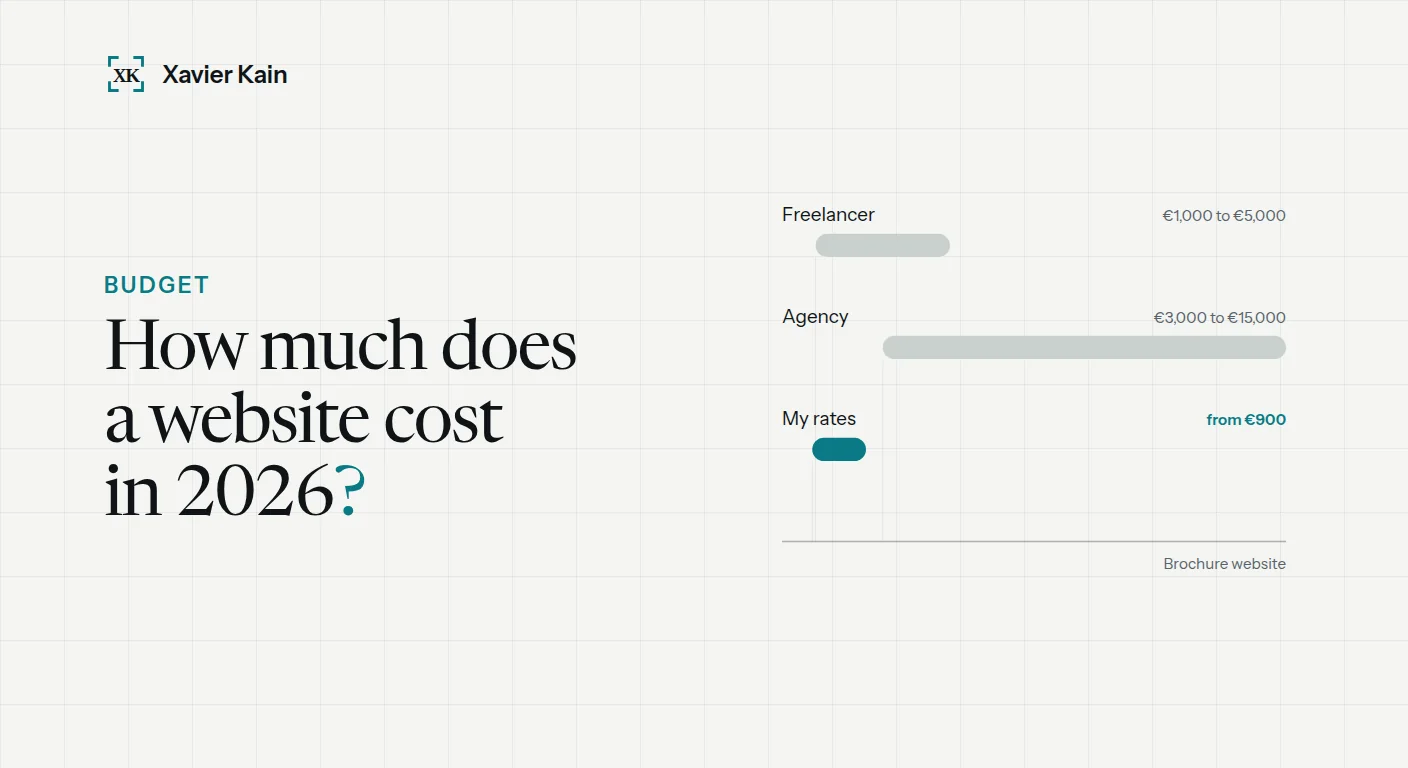
As a benchmark, with me a custom website starts at €900 excl. VAT and a simple WordPress site at €1,500 excl. VAT, delivered in about a week. The details are in the website pricing guide.
When doing it yourself is enough.
It would be dishonest to say you always need a professional. Doing it yourself, with or without AI, is enough when:
- you are testing an idea and want a page online today;
- it is a simple presentation page, with no payments or bookings;
- your business doesn't rely on Google to find clients.
As soon as the site has to sell, take payments, handle bookings, be found or last several years, bringing in a professional quickly pays for itself. And if your project doesn't need one, I'll tell you.
I use AI too.
AI is part of my everyday toolkit. It saves me time on repetitive work, and that saving comes back to you: professional quality at a freelance price. What it doesn't replace is the experience of more than 200 projects, the checks, and having someone who answers for the result. That is what you are paying for when you work with me.
FAQ: website with AI or a freelancer.
Can you build a professional website with AI alone?
For a simple page or to test an idea, yes. For a site that has to sell, take payments, be found on Google and last over time, AI produces a starting point but not the choices and checks that make a site actually work: customer journey, security, compliance, SEO, maintenance.
Do you use AI to build your websites?
Yes, every day. It saves me time on repetitive work, which lets me offer professional quality at a freelance price. The judgement, the checks and responsibility for the result remain mine.
How much does a website built by a freelancer cost compared with doing it yourself?
Doing it yourself costs a subscription of a few tens of euros a month, plus your time. With me, a custom website starts at €900 excl. VAT and a simple WordPress site at €1,500 excl. VAT, with the code and all access belonging to you.
Sources.
- Google Search Central: SEO Starter Guide, the basics of search engine optimisation
- web.dev: Core Web Vitals, the speed and user experience metrics used by Google
- CNIL: cookies and other trackers, the obligations of a professional website (in French)
- Defend Intelligence: "J'ai refait GTA 6 avec l'IA… et j'aurais pas dû", the passage on the Pareto principle, 29:39 to 32:27 (in French)